
I have received information that raises the likelihood of the ceasefire to be signed between Iran and the U.S. Still, I consider that the likelihood of a no-ceasefire deal dominates. I’ll detail these below.
The main point I want to discuss today is U.S. inflation, which keeps pondering me. We at GnS Economics have provided several scenario forecasts to break through the uncertainty relating to it. Our first scenario turned out to be too mild, while I consider the recent near-worst-case scenario relatively unlikely.
Moreover, we can consider also the scenario I published yesterday unlikely, because reaching it would practically require wiping out the Middle East oil production in the sequel of the hot war between Iran and the U.S. (Israel). This is of course possible in the time frame I proposed (within the next two weeks), but I would consider it unlikely (if the war continues)
Let’s now assess what would U.S. inflation be in a ceasefire.
An energy shock is already manifesting, but it will be more muted in the U.S. because of its semi-energy independence. Still, no one can escape this havoc.
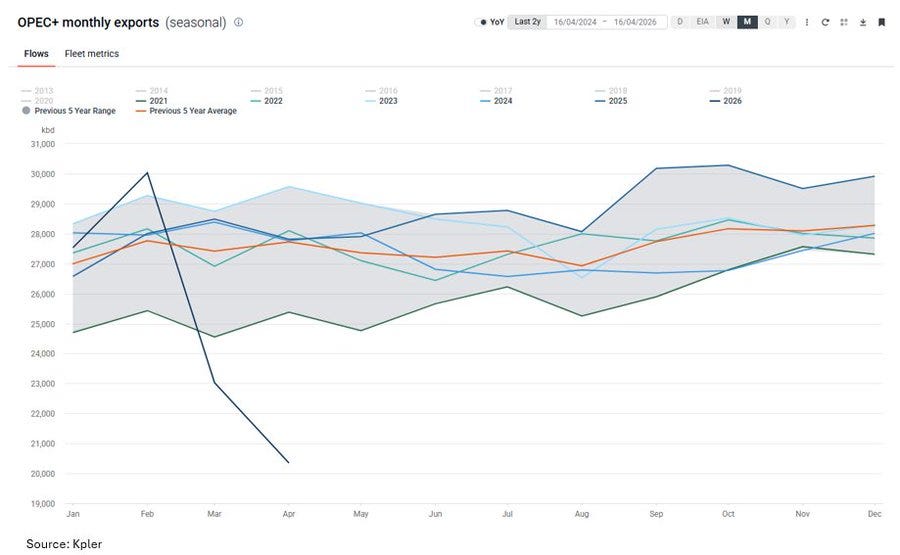
Moreover, even if the Strait were fully opened tomorrow, it would still take months for the flow of tankers to normalize and the damaged production to come online. In other words, energy shock will come, regardless.
The U.S. also needs to export certain types of oil for its refineries, including heavy oil, jet fuel, diesel, and gasoline, which account for over 6% of the total imports.1 The U.S. naturally imports several other petrochemical and non-petrochemical products, such as plastics, fertilizers, and chemicals, which further contribute to its reliance on global markets.
The above subjects the U.S. to global supply shocks. Like we noted in Weekly Forecasts 15/2026, the U.S. is not an island.
Let’s now incorporate these facts into a statistical model.
