The Double Standards
Why Israel and Russia are treated so differently?

Issues discussed:
The “unprovoked” war in Ukraine.
The “Greater Israel” project.
Russia is fighting an existential war, while Israel is fighting a war of expansion, but what unites them?
On Saturday, I published a short comment in X, which went viral. At the time of writing, the short entry had gathered over 1.3 million views and 66 thousand likes.
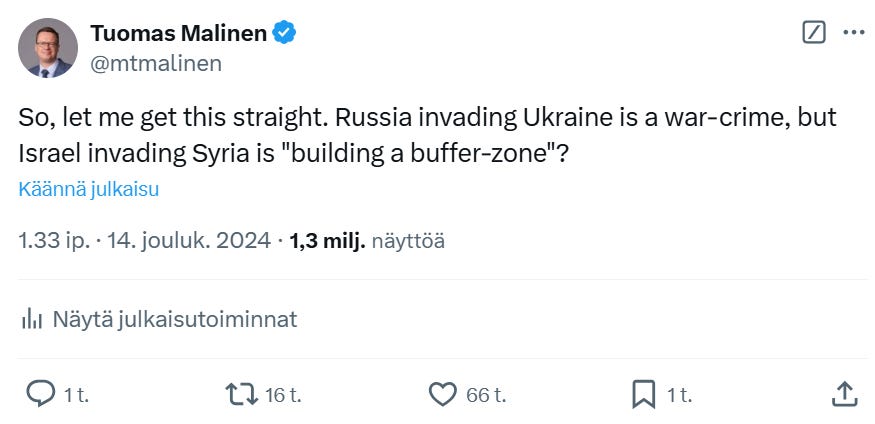
Based on the comments, it definitely hit a ‘nerve’ for many. In this entry I will dive deeper into these ‘double-standards’ applied in the two current theatres of war, Ukraine (Europe) and the Middle East.
Let’s begin with a notion relating, indirectly, to my Saturday’s post. It’s possible that the Israeli Defence Forces (IDF) detonated a tactical (low-yield, low-radiation) bunker-buster nuke in Tartous, Syria.
Remember the four hallmarks to recognize a nuclear explosion:
A very bright flash of light (“another sun”) at ignition.
A sound of a shotgun going off (from the explosion) followed by a roar.
Plasma generation.
Symmetry of the explosion (and damage).
First two are visible in the above video. This is a longer video with just the first moments of explosion missing.
Like noted before, I am not an expert in this matter. Yet, based on my reading on the new low-yield, low-radiation nuclear weapons we need to acknowledge the possibility that such weapons are already in use in some certain operations, like bunker-busting. It would be naive, and dangerous, to discard this possibility outright, because its implications are so dire.
Now, I am going to speculate a bit on the motives and treatment of the two ongoing wars. No matter how you look at it, there seems to be clear double-standards applied in how the mainstream media and many ordinary people view the two conflicts. Why is this? It’s my take that Russia and Israel serve two different aims of global elite in charge of the military-industrial complex and the Deep State. Let me elaborate.
For an untrained eye, it may appear that the motivation behind both wars, in Ukraine and the Middle East (Gaza), would be the same: threat. The difference is in the level of threat experienced.
The beginning of the second phase of the Ukrainian military conflict in February 2022 was presented to us as an over-reaction of Kremlin. The invasion was painted as an un-provoked attack of Russia to a friendly neighbour. In reality, of course, NATO had fought a war of provocation towards Russia since the fall of the Soviet Union in early 1990s. The enlargement of NATO to former Soviet nations was that provocation, like I explained in my long piece on the history of NATO and Russia. Kreml made absolutely clear to the U.S. administration during 2000s that it will not view the enlargement of NATO in Ukraine kindly. It was the final red-line of the Kreml. The history of Ukraine and Russia is complicated one, but the only thing you need to know is that both Napoleon and Hitler attacked Russia through it. Russian leadership considers it an existential piece in their security structure, like Mexico is for the U.S. These are the “buffer-zones” to these two nuclear powers, and if they would fall under control of the (supposed) enemy, they would pose a direct security threat and would be dealt with, swiftly and decisively. This is what Russia has been doing in Ukraine. Russia is, de facto, fighting a war it views as existential.
Israel has been under a different kind of threat since her inception, to Palestinian territory, in 1948. For example, the Six-Day and Yom Kippur Wars were existential to the Israeli state, and it won both of them. Syria has been one of her main adversaries in the region. The two countries have fought several wars. Now, the Syrian state has collapsed and taken over by terrorists, most likely, trained by Israel, the U.S. and some Arab states. Israel has just announced that it will double the population in the Golan Heights, it captured from Syria in the Six-Day War in June 1967 and annexed in 1981. So, there’s likely to be more to this than just building a “buffer-zone”.
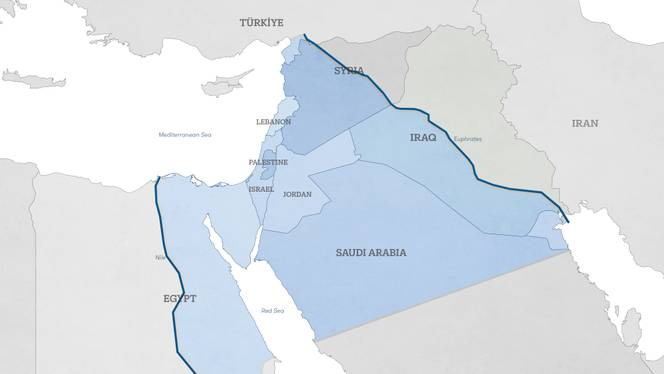
Israeli PM Benjamin Netanjahu stirred anger by presenting a map of “The New Middle East” in U.N. General Assembly, on September 22, 2023(!), where Palestine was within the borders of Israel. Francesca Albanese, the UN’s Special Rapporteur on human rights in the occupied Palestinian regions, has been warning on the expansionary plans of Netanjahu for years. Just two months ago (before the collapse of Syria) she re-iterated her warning in an interview summarized as “Idea of greater Israel fueling Netanyahu’s ideology”. She refers to Biblical prophesy (which some claim is an misinterpretation) of “Greater Israel”, which would stretch from Syria deep into Egypt and Saudi-Arabia. According to Dr. Albanese (and many others), many powerful political and religious groups in Israel are actively pushing this. The collapse of Syria fits to this aim perfectly.
Like mentioned before, I had a friend who served several tours and the U.N. Middle East intelligence. He told me already in 2008 that nothing in and around Israel happens without Mossad and the Shin Bet knowing about it. He told me few examples, which I cannot repeat here due to confidentiality. I do not believe for a second that the 10/7 attacks of Hamas to Israel came as a surprise, especially as Egypt warned on them months, and just days, before. Israeli leadership knew or at least they allowed the strikes to happen.
So, the difference between the wars in Ukraine and around Israel is that the former arises from (historically legitimate) security concerns and the latter from a ‘false flag’ operation masking an expansionary aim. Both Israel and Russia also ‘enjoy’ a highly differing global roles. Russia (the Soviet Union) was a long-time foe of West, while Israel has been a “first line of defence” for the West against Muslims since her inception. It is also rather well known that supporters of Israel (Jews or not) have a strong grip on U.S. politics. Some claim that the reach of ‘Zionists’ goes even further, globally, but I simply have not looked into the issue enough to comment.
If we look at the situation in these two hot-spots based purely on the developments they are creating, we can deduct that the two countries play two differing roles (of escalation) in the global power play. Israel is eliminating the obstacles from Western dominance of the Middle East, while Russia is creating a re-armament cycle and forced unification of Europe. Both can be seen to serve the aims of the military-industrial complex, the Deep State, the globalists, and the group-over-groups.
We can naturally speculate that the aim of the Russo-Ukrainian war was to weaken Russia and possibly to cause a coup d’etat dividing Russia into smaller parts. Based on the history of Russia, this is a tall order. Russians have the mindset of unifying under foreign threat and this is what we are seeing in Russia today (based on what I’ve heard). This is why I don’t consider this to be a realistic assumption of the ‘dark logic’ likely driving the Ukrainian conflict. The ‘powers that be’, most likely, want to create a perpetual military conflict in Europe, which would feed into increased defence spending (revenues), lowered threshold of ordinary people for deeper European unification and weakened moral and hatred (weak and hateful people can be controlled more easily). The aims of Israel to enlarge also feed weakened moral and hatred, but a war in the Middle East would create serious global consequences. It would breed economic hardship, poverty and possibly even famine, which are something the group-over-groups is likely to look for.
After the fall of the Assad government, Israel is free to do almost anything in Syria. It has already essentially destroyed Gaza. Greater Israel looks to be in construction. As a prizes, the West will get their Qatar-Turkey pipeline, while Israel will get the natural gas off the Palestinian coast and some lebensraum. Russia will get the most mineral-rich parts of Ukraine (in the East) and some bezopasnost.1
If the above narrative holds true, the double-standards in treatment (painting) of Russia and Israel would arise simply, because they serve two different purposes with the same goal. Russia is painted as the enemy (“evil”), because it serves the purpose of the entities listed above. For the same reason, there’s no to very little condemnation of what comes to actions of Israel. The two conflicts serve the same goal, that is, to divide, sow chaos and, eventually, unify under a global rule. Divide et Impera. When you look at the wars from this angle, the double-standards applied to Russia vs. Israel start to make sense, imho.
This became a rather speculative entry, again, but as an empiricist I need to find the logic that explains what we are seeing. Of course I sometimes miss (everyone does), but I have been wrong only few times during the past years. If I am right, we learn it soon, through a deepening cycle of escalation in the Middle East and in (and around) Ukraine.
Tuomas
Disclaimer:
The information contained herein is current as at the date of this entry. The information presented here is considered reliable, but its accuracy is not guaranteed. Changes may occur in the circumstances after the date of this entry and the information contained in this post may not hold true in the future.
No information contained in this entry should be construed as investment advice. Readers should always consult their own personal financial or investment advisor before making any investment decision, and readers using this post do so solely at their own risk.
Readers must make an independent assessment of the risks involved and of the legal, tax, business, financial or other consequences of their actions. GnS Economics nor Tuomas Malinen cannot be held i) responsible for any decision taken, act or omission; or ii) liable for damages caused by such measures.
From the Russo-Ukrainian war III:
There had been five major invasions in Russian historical memory, where the Russian state had become under existential threat. First one was the Polish occupation of the Kremlin in the early 17th century, the Swedish aggressions in the 18th century, the Napoleon invasion of 1812, and two wars with Germany in the first half of the 20th century. In this way, suspicion and fear of the West developed in the Russian mentality, even before the Bolshevik revolution in 1917. This is probably, what created the concept bezopasnost, which direct translation is “the absence of threat”, and through which Kremlin views the situation in its neighboring regions.